

Heirloom Gardens
The world we live in today is much different than our ancestors a century ago. Our heirloom gardens are designed to look back at historic gardens, crops, and practices so we can appreciate where we are today and learn.
Heirloom gardens add another dimension to your museum and historic village experience. Eye-catching blossoms, fragrant herbs, luscious fruits, and rows upon rows of colorful vegetables all vie for your attention. They are also used regularly by our historic Pinecrest Village interpreters for preparing meals in historic kitchens, dyeing fibers, medicinal preparations, decorations, and craft projects.
Learn more about our kitchen gardens, heirloom varieties and orchards below.
Meeme House Kitchen Garden
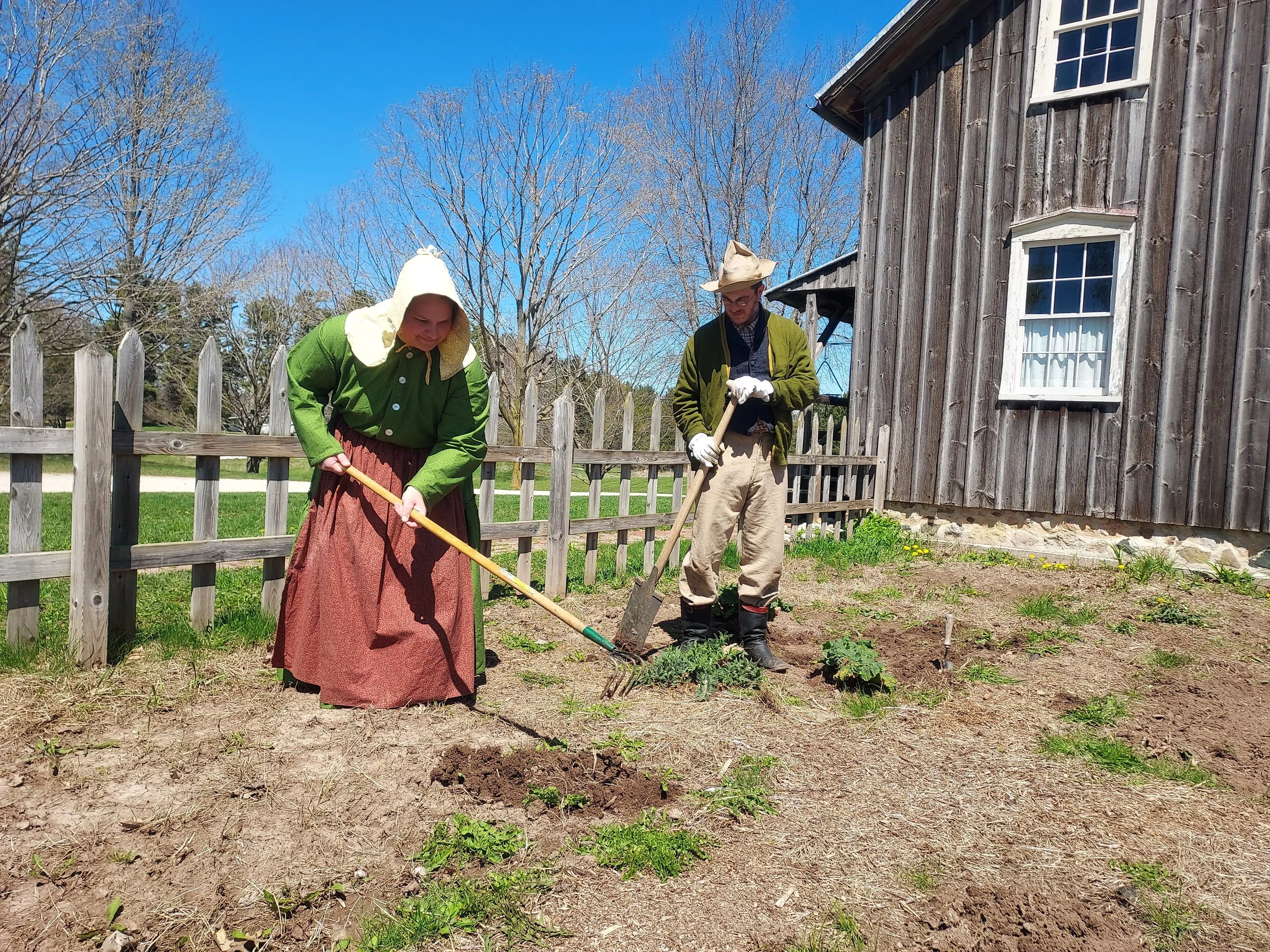
The heirloom garden at the Meeme House (c. 1854, Meeme Township) contains hardy crops commonly grown in the 19th-century kitchen garden. These vegetables are grown from seed “bred back” to original types. Among the vegetables often grown here are Danvers Half Long carrots, early Jersey Wakefield cabbage, and China rose radish. These varieties would have been grown and saved for their flavor and storage capacity. This garden also features perennial herbs, fruits, and vegetables such as raspberries, strawberries, sorrel, walking onions, mullein, oregano, and more.
This garden also has some herbs for practical and culinary uses: lovage, tarragon, dill, and mint. The garden is surrounded by fruit trees. What’s grown in the Meeme House kitchen garden is regularly utilized by the historic cook working inside!
Carsten Makerspace Garden
The Carsten Garden (c. 1860, Netwon Township) is an example of an early vegetable and practical garden. It is an early German style garden set apart by its plots and paths. One or two items are grown in each plot.
Everything grown in this garden is utilized! Vegetables grown here are appropriate for an early 20th-century time period, including dryables like peas and beans, garlic, onions, or easily cooked-up options like cabbage or lettuce.
Herbs are planted around the base of the House such as mint, lemon balm, and horseradish. Much of the food stuffs consumed by a family in a dwelling like this would have been foraged from the countryside: berries, acorns, sumac, ramps, and mushrooms.
The Hop Yard
Grown vertically on poles, hops are a perennial vine that is grown as a flavoring and a preservative/stabilizing agent in the brewing process. When harvest time came, the whole community would have a picnic, perhaps bring in a band, and make a social event of the harvest.
Heavy gloves were worn to avoid the sticky, sharp nature of the bines. Harvest basket contents were evaluated by weight. The flowers were dried in heated buildings and pressed into bales.
During the late 1860s, Wisconsin cornered an astonishing part of the hops market in the United States. The end of the Civil War combined with the hop aphid’s arrival in New York inflated the price of the crop by 700%. Returning soldiers took advantage. In 1860, Wisconsin produced 135,000 lbs. of hops. By 1867, the state’s production was over 6 million pounds – quickly replacing New York as the top producer. By 1868, the crop failure that had affected New York had been delt with; the market flooded, prices dropped and it was the end of the “Hops Craze” in Wisconsin. The replacement crop? Dairy. In under a decade, Wisconsin went from being America’s Breadbasket to the Dairy State.
Here is Spalt and cluster varieties of hops. Spalt hops are one of the world’s oldest hop varieties. Dating back as far as the 8th century , Spalt hops was the first variety to be granted the German hop seal in the 16th century. The German hop seal was a certification system predating the current, German Hop Provenance Law. Spalt was grown primarily in the Spalt region of Germany. Spalt has notes of earth and spice. Spalt are considered one of the four classic noble hops, alongside Hallertau, Tettnang, and Saaz.
Pollinator Spaces
Did you know that every third bite of food we eat is due to pollinators?
It's true! Honey bees, butterflies, birds and other pollinators help grow our food, keep our flowers blooming and make our lands healthy. However, for many reasons, including lack of habitat, pollinators are struggling. The plight of honeybees, native pollinators and the monarch butterfly have placed a renewed sense of urgency on the development and conservation of habitat for these crucial ecological workhorses.
The Manitowoc County Historical Society has 2 pollinator habitat spaces: 2 acres near the Collins Depot and an acre field behind the Cheese Factory.
This effort is made possible in partnership with the Manitowoc County Farm Service Agency, Millborn Seeds, and the Bayer Feed a Bee program.

The Orchards
A number of orchards can be found around the grounds at the Manitowoc County Historical Society. Apple trees were often seen as the cheapest crop a farmer could grow – you could plant once, and harvest for years.