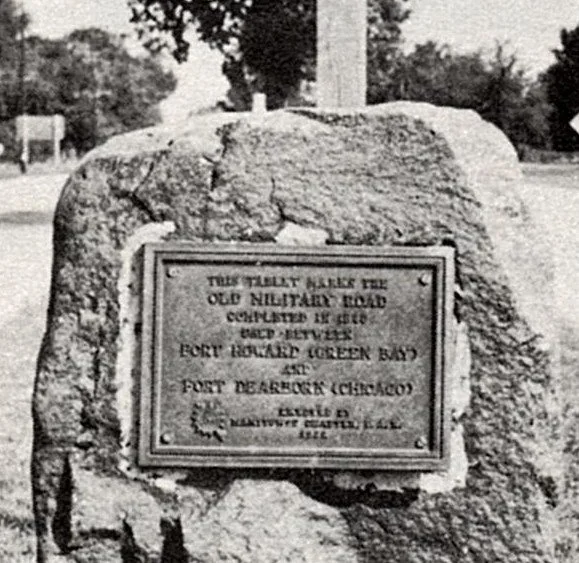
The Old Military Road monument was dedicated by the Manitowoc chapter, D.A.R. at the west end of Waldo Blvd. in 1932.
On Saturday, May 21, 1932, the Manitowoc chapter of the Daughters of the American Revolution (D.A.R.) dedicated a stone marker and bronze tablet for the Old Military Road and planted an American elm tree in honor of the 200th anniversary of George Washington’s birth. The markers were erected at the west end of Waldo Blvd. near the junction of the Green Bay Road (old US Highway 141, now N. Rapids Road). Many readers will recall this T-intersection, before Waldo Blvd. extended west to I-43.
The Military Road from Fort Howard, Green Bay to Fort Dearborn, Chicago, was surveyed and marked out, by way of Milwaukee and Racine, in the spring of 1835. It followed an old Indian trail through “an excellent woodland district which stretches along the western shore of Lake Michigan.” In 1839, Lieut. Thomas Jefferson Cram, U. S. Army Corps of Topographical Engineers, reported the road was “nearly all the way through.”
Other military roads were built by soldiers from the frontier forts while Wisconsin was part of Michigan Territory. An earlier road linked Forts Howard, Winnebago and Crawford, from Green Bay to Portage and Prairie du Chien. Another connected Milwaukee with East Dubuque, by way of Madison.
By the time the first settlers in Manitowoc County arrived in the 1830s, the north-south lakeshore trail was used by trappers, traders and mail carriers, who walked and carried the mail on their backs. Early mail stops along the Military Road in Manitowoc County were Cooperstown, Manitowoc Rapids and Meeme.
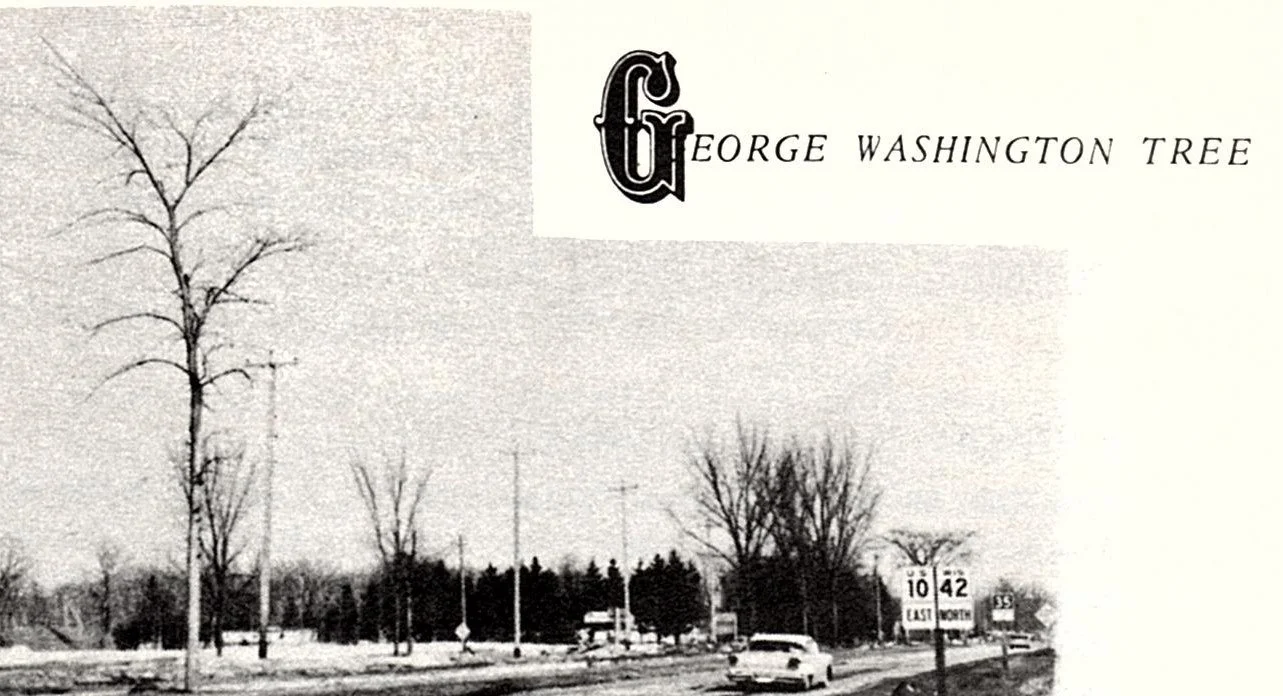
This 1964 photo shows the elm (large tall tree, at left) planted at the west end of Waldo Blvd. by the Manitowoc chapter, D.A.R. in honor of the 200th anniversary of George Washington’s birth in 1932.
The D.A.R. dedication program of the Old Military Road marker began at 2:30 p.m. with “Attention” by bugler William Wagner of Company E, 127th Infantry and the assembly singing “America,” accompanied by the Woodrow Wilson junior high school band. This was followed by the recitation of “Washington’s Prayer” from 1783 and a salute to the flag. Dedication remarks were given by Mrs. William H. Pauly, Manitowoc D.A.R. chapter regent, and Mrs. Joseph A. Branson, De Pere, state D.A.R. regent. The program ended with a march played by the band.
Permission to plant the elm tree, east of the Military Road marker in a strip of land, was granted through the cooperation of Edward Berkedahl, county highway commissioner, at a special meeting of the county zoning committee at the courthouse on January 22, 1932.
During the tree dedication, Mrs. Ross Wright, charter member, Manitowoc chapter, D.A.R., read Lucy Larcom’s poem “Plant A Tree.” The bugler sounded “Taps” and the audience sang the National Anthem, played by the Wilson band. Manitowoc Boy Scouts served as color bearers and guards.
The tablet inscription read: In Memory of George Washington, 1732-1799. This tree is planted by the Manitowoc Chapter, D. A. R. in bicentennial year of his birth, 1932.
Following the ceremonies, an evening banquet for D.A.R. members and invited guests was held at the home of Mrs. Charles M. Gleason, Manitowoc.
News of the dedication ceremonies appeared in The Manitowoc Herald-Times on May 19, 20 and 23, 1932.
In subsequent years, an automobile crashed into the George Washington elm in the 1950s, and the tablet loosened and disappeared. The elm tree was later cut down, possibly the result of Dutch elm disease or safety concerns.
During road improvements, the Military Road monument was moved to the east side of N. Rapids Rd., a short distance north of Waldo Blvd. Today, the marker is safely displayed near the First Court House and Jail marker on the public square at Manitowoc Rapids.