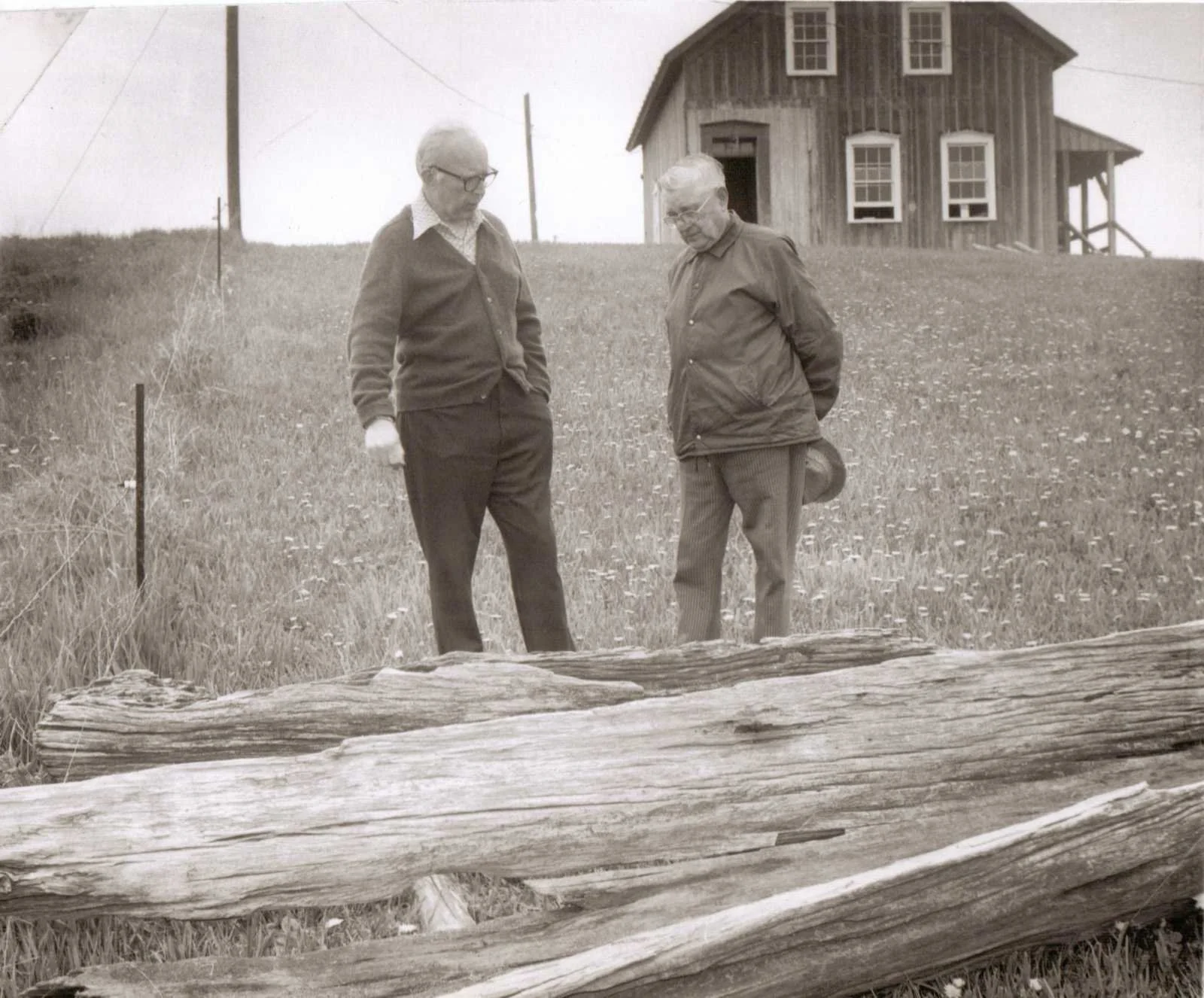
Don Groll, left, and Ed Ehlert, right, at Pine Crest Historical Village inspect the wooden dugout canoes found at Glomski Lake in 1979.
The recent discovery of sixteen dugout canoes, including one estimated to be 5,200 years old, in Lake Mendota at Madison, Wisconsin, is exciting and expands our knowledge of Native American water craft and maritime history in the Western Great Lakes region. Archaeologists at the Wisconsin Historical Society found all of the canoes in the same shallow section of the lake near the UW-Madison campus in Dane County.
Native people used dugout and birchbark canoes to hunt, fish, collect wild rice and travel the region’s many inland lakes and rivers – which served as a network for transportation, communication and trade. When waterways were frozen, canoes were stored for the winter by filling them with rocks or sediment to sink them in fresh water. This prevented drying out and warping, and protected them from wind and ice damage.
Readers and local history buffs may be surprised to learn that two Indian dugout canoes were recovered from Glomski Lake, off Highway 42, in the Town of Newton, about three miles southwest of Manitowoc, in the spring of 1979.
The canoes were reported by Bernard Novy and salvaged by a team of CETA workers who were restoring the Carstens building at Pine Crest Historical Village. According to the Manitowoc Herald-Times-Reporter on May 3, 1979, one of the canoes had been spotted partially submerged as early as 1939. The second canoe was found by Village workers.
The canoes were donated to the Manitowoc County Historical Society, of which Mr. Novy was a member, and taken to Pine Crest Historical Village, three miles west of Manitowoc on CTH JJ, where they were “made an object of special viewing” that summer.
No hand tools, net weights or sinkers, fish hooks or traps were reportedly found in or near the canoes.
The largest and best preserved canoe measured 12 feet long × 25 inches wide with a 12-inch interior wall height. It was made by cutting down a large Eastern white pine (Pinus strobus), then hollowing out (possibly through burning) and chipping away the interior of the solid log with stone or metal hand tools. There are no thwarts or cross members on the inside bottom of the canoes.
A small specimen of wood from the large canoe was identified as pine by the USDA Forest Products Laboratory, Madison, in 2001. Recent analyses of wood samples from the Lake Mendota canoes indicate they are made of oak (red and white), elm, ash, basswood and pine – locally available wood types found in southern Wisconsin.
In 2023, radiocarbon dating of a wood sample taken from the back or underside of the better preserved dugout canoe from Glomski Lake determined that it is from 1840-1900 AD, or about 120-180 years ago. Researchers believe this date may be anomalous due to a treatment of shellac that was applied to the wood canoe after its discovery, probably to conserve and preserve it.
Further sampling and wood analysis may indicate the canoe dates from an earlier time period.
The large dugout canoe was on display for public viewing in the Prehistory/Archaeology gallery at the newly renovated Manitowoc County Heritage Center, 1701 Michigan Avenue (former Manitowoc County Teachers College), from 2001 until 2016, when the historical society moved its offices, archives and research library to Pinecrest Historical Village. It was then displayed for a time at UW-Manitowoc County. The canoe is currently in storage.
Heightened awareness, further research and underwater exploration of the state’s inland rivers and lakes by archaeologists may uncover additional Native American dugout canoes buried in mud and silt – important tangible links to the past.
According to The Wisconsin Dugout Canoe Project, Wisconsin now has 120 reported dugout canoes, the second most in the eastern United States. Florida ranks first with more than 400.
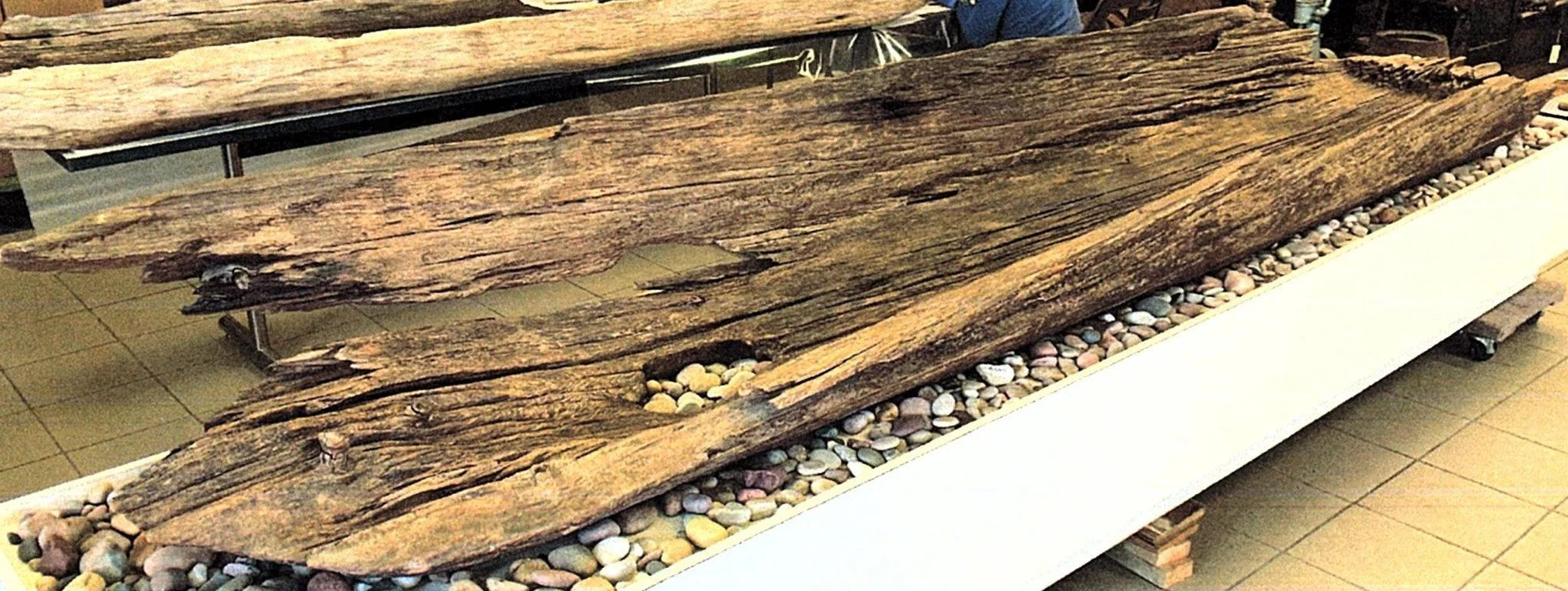
This dugout canoe found in Glomski Lake in 1979 was displayed at the former Manitowoc County Heritage Center from 2001-2016.