Fenians in Manitowoc County and The Fight for Irish Independence
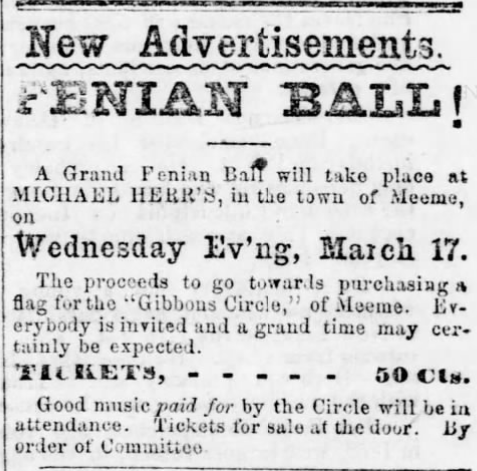
Fenian Ball advertisement, The Manitowoc Pilot, Feb. 26, 1869
A little known story in Manitowoc County history is noteworthy as we celebrate St. Patrick’s Day and all things Irish on March 17. And it has nothing to do with corned beef and cabbage or green beer.
Following the failed Young Ireland insurrection in 1848 to free Ireland from British rule, Irish patriots, led by James Stephens and John O’Mahony, came to America and founded the Fenian Brotherhood in New York City in 1858. Stephens returned to Ireland and founded the counterpart, Irish Republican Brotherhood. Members of both organizations were called Fenians.
The name ‘Fenian’ was derived from ‘Fianna,’ the miliary force led by Fionn MacCuchail (Finn MacCool), a heroic warrior of Celtic legend.
The Fenian movement spread rapidly in Ireland, among the growing Irish population in Britain and also in the United States, where many emigrated to escape the famine during the mid-1840s. Hundreds of Fenian Circles (or chapters) were organized to raise money, arms and men.
Despite being a ‘secret’ society, the existence of the Fenian Brotherhood was well-known. Its circles were found in every part of Ireland and America. During the 1860s and 1870s, national conventions of American Fenians were held in Chicago, Cincinnati, Philadelphia, Pittsburgh, Cleveland, New York and other cities.
Once the American Civil War was over in 1865, the Irish rebellion began. Fenian organizers believed many Union and Confederate soldiers of Irish descent would go to Ireland and join the fight for independence. In 1866 and 1867, Fenians attacked police stations in Ireland and set off bombs in England. Hundreds of rebels were arrested and imprisoned.
In 1866, Irish-American Fenians, mostly Civil War veterans, crossed the border into Canada in three raids that failed to seize Canadian territory (part of British North America) and pressure the British government to withdraw from Ireland. There were casualties on both sides. Most Fenians escaped back across the border.
Following the raids, the belief for a united and independent Irish state remained strong. Fenian circles were organized in Manitowoc County at Manitowoc, Meeme, Maple Grove and Cooperstown. Money was raised for the Brotherhood and Irish liberty by taking up collections at fiery speeches and hosting ‘grand balls.’
On the evening of March 17, 1869, a “Grand Fenian Ball” was held in Michael Herr’s “large commodious Hall” in the town of Meeme (Sessler’s Meeme House was moved to Pinecrest Historical Village in 2017). Tickets for the St. Patrick’s Day dance cost 50¢ and were sold at the door - “a small pittance” for any “person with love for the oppressed, the downtrodden and the exiled.” Proceeds went toward purchasing a green flag, a traditional symbol of Irish nationalism.
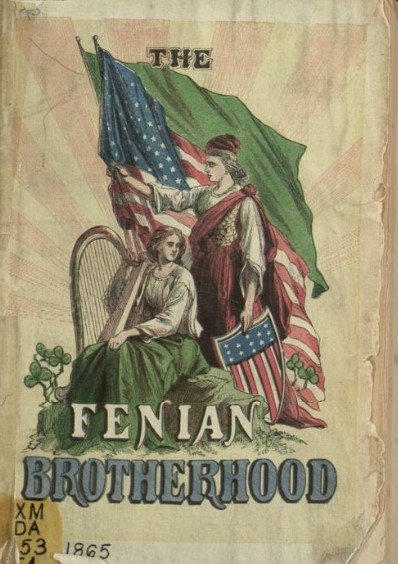
Illustration from The Fenian’s Progress: A Vision, 1865
Another “grand ball” was held at John Morrissey’s hall in Maple Grove on August 14, 1869. All were invited to attend.
News of the Fenian Brotherhood in America and the Irish Republican Brotherhood was extensively covered in The Manitowoc Pilot, edited by Jeremiah ‘Jere’ Crowley, born in County Cork, Ireland.
In 1871, Irish-American Fenians, led by John O’Neill and William O’Donoghue, attempted to invade Manitoba, but mistakenly took over a U.S. Customs House and Hudson’s Bay Company post near Pembina, Dakota Territory. They were quickly arrested by the U.S. Army, with no casualties.
During the 1880s, the Fenian Brotherhood in America disbanded due to internal divisions and the loss of public support for further armed invasions of Canada. Its successor group, Clan na Gael, continued the fight for Irish liberty and freedom.
Until the end of World War I, the Irish Home Rule Movement, led by Charles Stewart Parnell and others, became the political and parliamentary means for achieving self-government. When the home rule campaign stalled, the goal of Irish independence through armed rebellion was again attempted. Following the six-day Easter Rising in April 1916 and guerilla warfare that followed, the Irish Free State was established in 1921.