Pulaski Square Monument was Dedicated in 1929
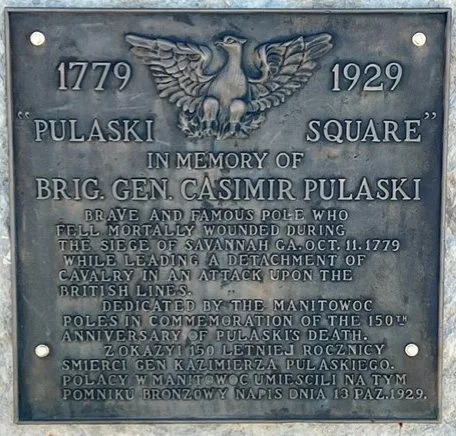
Casimir Pulaski memorial tablet as it appears today at Pulaski Park in Manitowoc.
Photo by Bob Fay
On Sunday, October 13, 1929, a bronze tablet honoring Count Casimir Pulaski, “defender of Polish freedom” and the “Father of the American cavalry” was dedicated at Pulaski Square (today’s Pulaski Park) on Manitowoc’s southside. The event joined other communities across the United States to honor the Polish nobleman and soldier on the 150th anniversary of his death.
According to The Manitowoc Herald-News, thousands lined the walks as a parade, led by the Aluminum Goods Marine Band, went from St. Mary’s school grounds to Pulaski Square where about 5,000 people had assembled for the memorial dedication. Members of Polish societies (many dressed in colorful ethnic clothing and carrying flags and flowers), American Legionnaires, National Guardsmen and school children marched. Automobiles carried speakers and city officials.
Rev. Jan Pociecha, pastor of St. Mary’s Catholic Church, was master of ceremonies at the dedication. Mayor Martin Georgenson told of work to make Pulaski Square “a beauty spot and leading recreation center.” Land for the park had been acquired in 1921 and 1924. In 1926, the city property was named “Pulaski Square” at the request of Polish residents of Manitowoc’s Seventh Ward to honor Casimir Pulaski whose life and deeds were warmly cherished.
Atty. John Healy of Manitowoc told the story of the Polish military commander who came to America in 1777 to help Gen. Washington’s forces in the fight for independence from Great Britain. Pulaski was made a brigadier-general in the Continental Army and fought at the battles of Brandywine (1777) and Germantown (1777). He organized a corps of cavalrymen called Pulaski’s Legion and was mortally wounded at the battle of Savannah (1779).
Judge Magiera of Indiana addressed the audience in Polish, telling them that the liberty which Polish people so highly prize in America was due to the efforts of Pulaski and others like him who fought in the American Revolution (1775-1783).
Atty. Leon Hojnacki of Milwaukee also spoke in Polish, telling his compatriots to be proud of their nationality and ancestry. Judge Joseph Wipiszynski of South Bend, Indiana, speaking in English, stressed the need for Manitowoc’s Poles to give their children an education.
The memorial tablet was unveiled by Pauline Greca, Celestine Budnick, Violet Sobiesczyki, Leona Jagodzinski and Caroline Budysz. The school girls were dressed in national costumes.
The top of the bronze tablet featured an eagle with spread wings, representing Polish sovereignty, unity and freedom. The inscription below read: 1779 1929 “Pulaski Square” in Memory of Brig. Gen. Casimir Pulaski Brave and Famous Pole Who Fell Mortally Wounded During the Siege of Savannah Ga. Oct. 11, 1779 While Leading a Detachment of Cavalry in an Attack upon the British Lines. Dedicated by the Manitowoc Poles in Commemoration of the 150th Anniversary of Pulaski’s Death.
There was also a Polish inscription at the bottom of the tablet: Zokazyi 150 Letniej rocznicy Smierci Gen Kanimierza Pulaskiego. Polacy W Manitowoc Umiescili na tym Pomniku
Bronzowy napis Dnia 13 Paz. 1929. Translated, it read: On the occasion of the 150th anniversary of the death of General Casimir Pulaski, Poles in Manitowoc placed this inscription on the bronze monument on October 13, 1929.
The musical program included both the American and Polish national anthems played by the band and Polish songs by St. Mary school children and the church choir.
As part of the observance, eighth grade students at St. Mary’s school wrote essays on the life of Gen. Pulaski. An essay by Leona Jagodzinski appeared in the Herald-News a few days after the dedication.
Today, the refurbished Pulaski Square tablet is mounted on a stone monument in the park near the southwest corner of Columbus and S. 17th streets.